Dwarkadhish Temple, Dwarka – Timings, Festivals, History, Darshan, Pooja Timings
The ancient Hindu temple Dwarkadhish Temple is located in the holy town of Dwarka, Gujarat, three km from Dwarka Railway Station. Lord Krishna, also known as Dwarkadhish or “King of Dwarka,” is worshipped in Dwarkadhish Temple, also known as Dwarkadheesh Temple, which is located on the banks of the Gomti River. It is a part of the renowned Char Dham, which consists of four ancient temples devoted to Lord Vishnu, along with Rameswaram, Badrinath, and Puri. It is also known as Jagat Mandir or Trilok Sunder Temple. It adheres to the rules and customs established by Vallabhacharya and Vitheleshnath because it is a Pushtimarg temple. It is one of the most important locations in Dwarka and one of the most respected temples in Gujarat.
History of Dwarkadhish Temple, Dwarka
On the location of Lord Krishna’s residence more than 2,500 years ago, his great-grandson Vajranabh is thought to have built the highly revered Dwarkadhish Temple. The temple has undergone multiple restorations and renovations over the course of its existence. The ancient structure was repaired and improved in the 16th century after Mahmud Begada demolished it in the 15th and 16th centuries. Aniruddhasrama Sankaracharya erected the current Dwarkadhish idol in 1559.
Mythology of Dwarkadhish Temple, Dwarka
The story of Lord Krishna is connected to the Dwarkadhish Temple in Gujarat. According to the Mahabharata, after defeating his uncle Kansa in Mathura, Krishna established the city of Dwarka. Kansa’s father-in-law, Jarasandha, besieged Krishna’s domain seventeen times as payback for Kansa’s death. In just two days, Lord Krishna moved his capital from Mathura to Dwarka, a city created especially by the Hindu architectural deity Vishwakarma on a land area of 12 yojanas (96 sq. km) that had been sanctified by the sea god. The city was called “Suvarna Dwarka” because the homes within Lord Krishna’s “Suvarna Dwarka” were embellished with gold, emeralds, and precious stones.
According to legend, Lord Krishna ruled the entire Dwarka realm from his initial residence at Bet Dwarka. Furthermore, according to mythology, the city was submerged under the sea after Lord Krishna left his corporeal form, and Samudradeva took back what he had previously given. It is believed that Vajranabha, the great-grandson of Lord Krishna, built the Dwarkadhish Temple as a memorial to the esteemed god.
Architecture of Dwarkadhish Temple, Dwarka
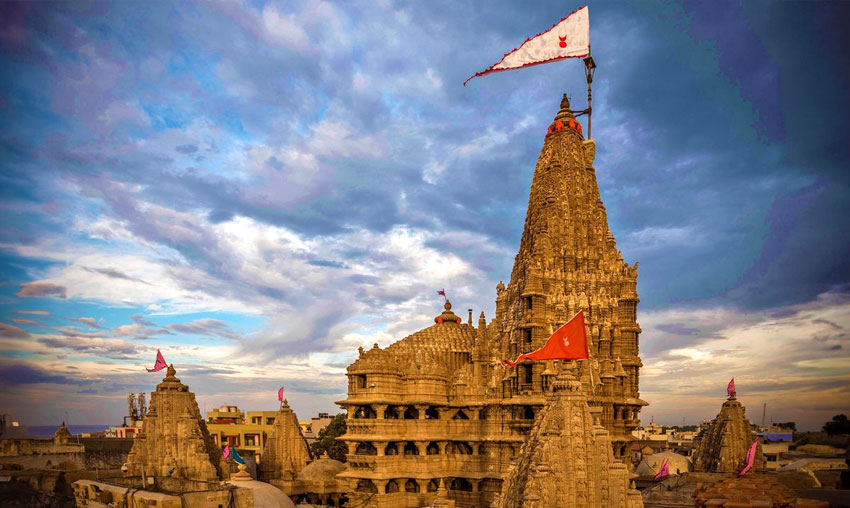
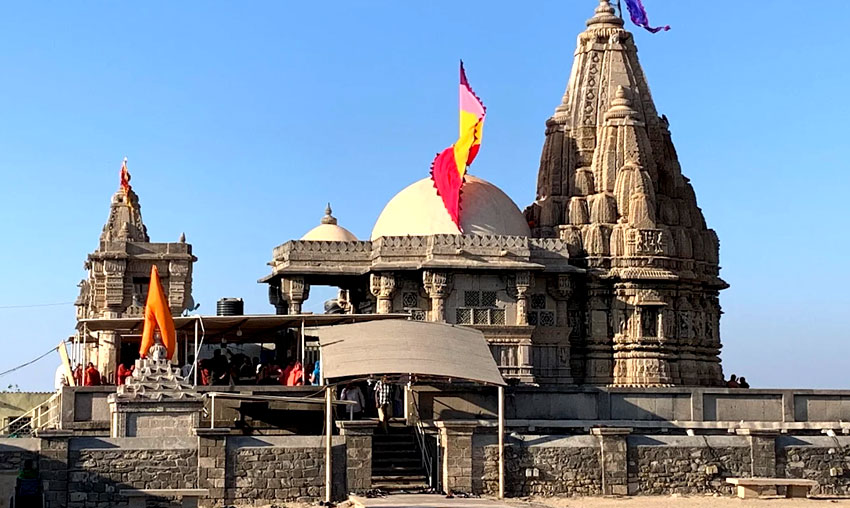
The Chalukyan architectural style is seen in Dwarkadhish Temple, which was constructed from soft limestone. Supported by 72 pillars, the five-story main shrine is impressive. The temple is made up of a rectangular hall with porches on three sides, a sanctum, and a vestibule. It features a massive flag composed of 52 yards of cloth and a beautifully carved 42-meter-tall shikhara. The temple has two primary entrances. Moksha Dwar is the name of the main entrance (the north entrance), and Swarga Dwar is the name of the south entrance. There are 56 steps leading to the Gomati River outside Swarga Dwar. Before entering the temple through the Swarga Dwar, pilgrims are supposed to swim in the Gomti River.
While the interior is straightforward and serene, the exterior is decorated with elaborately carved sculptures and motifs from Hindu mythology that portray the events of Krishna’s life. The temple’s sanctuary sanctorum is home to the majestic black idol of Lord Krishna, who is shown as a radiant king with four arms that carry the gada, lotus flower, Panchajanya or conch, and Sudarshana Chakra. Trivikrama is the eighth avatar of Lord Vishnu and is an image of Lord Krishna. The temple has other shrines dedicated to Subhadra, Balarama and Revathi, Vasudeva, Rukmini, and numerous more deities. Additionally, Adi Shankaracharya had a seat here.
The temple of Dwarkadhish is well-known for its flag worship and is one of the best locations to visit in Dwarka. The flag, or Dhwaja, is changed four times a day and is regarded as being of utmost importance in the temple. Stitched from 52 yards of cloth, the flag is a spiritual icon with depictions of the sun and moon that are thought to symbolise Krishna’s continued presence on Earth as long as the sun and moon exist.
Festivals of Dwarkadhish Temple, Dwarka
Every year in August or September, millions of devotees flock to Dwarkadhish Temple to witness the magnificent celebrations of Janmashtami, the most significant festival. The lord is adorned with an abundance of gems, including gold, diamonds, and topaz, in his most regal form during this celebration. Other well-known holidays observed at this temple are Holi, Rukmini Vivah, Basant Panchami, Ram Navami, Akshay Tritiya, Deepawali, and Sharad Purnima.
Dwarkadhish Temple Dress Code
Wearing modest clothing that covers the upper arms and legs is a sign of respect when visiting the Dwarkadhish Temple in Dwarka. Men should think about wearing formal pants and shirts or a dhoti or pyjamas with an upper garment. Women can choose to wear chudidhars, half sarees, or sarees. When visiting the temple grounds, it is advised to stay away from contemporary attire such sleeveless tops, jeans, shorts, and miniskirts.
The Dwarkadhish Temple in Dwarka is normally open to non-Hindus. The temple is open to tourists of all faiths who want to enjoy its architectural beauty, cultural significance, and historical significance.
Dwarkadhish Temple, Dwarka Timings
Monday: 6:30 AM – 1 PM & 5 PM – 9:30 PM
Tuesday: 6:30 AM – 1 PM & 5 PM – 9:30 PM
Wednesday: 6:30 AM – 1 PM & 5 PM – 9:30 PM
Thursday: 6:30 AM – 1 PM & 5 PM – 9:30 PM
Friday: 6:30 AM – 1 PM & 5 PM – 9:30 PM
Saturday: 6:30 AM – 1 PM & 5 PM – 9:30 PM
Sunday: 6:30 AM – 1 PM & 5 PM – 9:30 PM
Dwarkadhish Temple, Dwarka Entry Fee
General Entry is Free
Special Darshan available for Rs. 200
VIP Darshan available for Rs. 500
Best Time to Visit Dwarkadhish Temple, Dwarka
October through March is the best time to visit Dwarka Temple because of the town’s chilly winters, which are great for exploring the temple. It will be exciting to visit the temple around August or September if you want to take part in the great celebrations of the Janmashtami festival. Thousands of people visit the temple and take part in the celebrations at this period, bringing the entire town to life. On the other hand, the monsoon season, which runs from July to September, is marked by heavy rainfall and strong winds, making it unsuitable for travel, while the summer months, which run from April to June, may be quite harsh due to high temperatures.
How to Reach Dwarkadhish Temple, Dwarka
The closest airport, Jamnagar Airport, serves direct flights from Mumbai and is approximately 126 kilometres from Dwarka. Okha, Tuticorin, Guwahati, Gorakhpur, Rajkot, Ahmedabad, Somnath, Allahabad, Varanasi, Puri, Rameswaram, Jaipur, Bhavnagar, Kochi, Howrah, Nathdwara, and Viramgam are all easily accessible by train from Dwarka Railway Station. Rajkot, Ahmedabad, Amreli, Porbandar, Somnath, Gandhidham, Bhuj, Gandhinagar, Baroda, Bhavnagar, Surat, Jamnagar, and Junagadh are all easily accessible by road from Dwarka. Dwarkadhish Temple can be reached from these locations by using an autorickshaw or taxi.
Nearby Places to Visit