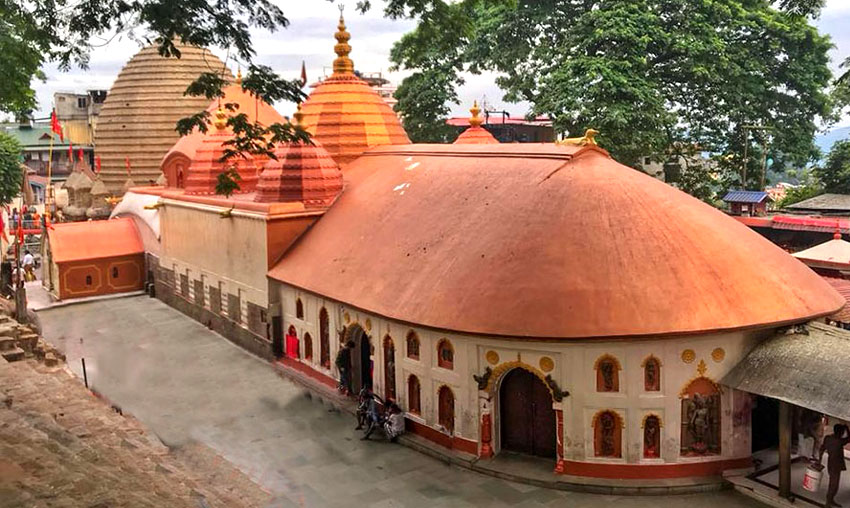
Kamakhya Temple, Guwahati – History, Darshan, Pooja Timings
One of the most revered shrines of Goddess Shakti in India is Kamakhya Temple, which is situated on the Nilanchal Hill in the western region of Guwahati, Assam. Kamakhya Temple is one of the four significant Shakti Peethas (Temples with highest powers of divinity) in the nation, according to Hindu scriptures. The Tantrik sect of Hinduism considers Kamakhya Temple, which honors a woman’s ability to give birth, to be very fortunate. It is a sight in and of itself, having been constructed and rebuilt several times between the eighth and seventeenth centuries.
The Kamakhya temple’s main entrance is exquisitely ornamented with vibrant flowers and simple yet stunning woodwork. The temple’s enormous dome provides a view of the picturesque Nilanchal Hills. It is particularly decorated for the three to four days of the Ambubachi Festival in June.
History of the Kamakhya Temple
The Kamakhya Temple has a lengthy and distinguished history because it is among the nation’s oldest temples. This temple is thought to have been constructed in the eighth or ninth century, under the Mleccha dynasty. This temple became a major hub for Tantrikism during the time of the Kamarupa Kings, who were devoted adherents of the Tantrik cult from Indra Pala to Dharma Pala. The significance of the temple as a location for Tantrik sacrifices and sorcery was emphasized by the Kalika Purana, which was written in the tenth century. Around that time, mystic Buddhism, also known as Vajrayana, developed here, and several Buddhist scholars in Tibet were known to be Kamakhya.
Hussein Sha’s assault of the Kamata kingdom resulted in the destruction of the Kamakhya temple. Until Vishwasingha, the founder of the Koch Dynasty, restored the temple as a place of devotion in the 1500s, the ruins remained unnoticed. Since its reconstruction in 1565, during his son’s rule, the Kamakhya temple has been a significant religious hub for Hindus worldwide.
Structure of the Kamakhya Temple
The Kamakhya temple’s current structure is described as being of the Nilachal type, which is another term for buildings with a cruciform base and a hemispherical dome. The four chambers of the temple are arranged from east to west and are as follows:
1. Garbhagriha: The main sanctum, or Garbhgriha, is situated on a base with several sunken panels adorned with statues of Ganesha and other Hindu deities. The Garbhagriha’s octagonal apex is constructed of bricks, while its lower portions are composed of stone. A set of steps carved out of rock leads to the Garbhariha, which is located below ground. Here is a rock fissure that resembles a vulva-shaped depression and is revered as the goddess Kamakhya. The general design of all the Garbhagrihas in this temple is that the depression is filled with water from an underground spring.
2. Calanta: The Calanta, a square-shaped chamber of the atchala type, is located west of the Kamakhya temple. This room has small, movable idols of gods and goddesses, as well as numerous images and inscriptions carved into the walls.
3. Pancharatna: The Panchratna, a big rectangular building with a flat roof and five little spires extending from it, is located west of the Calanta.
4. Natamandir: The last Natamandir building, located west of the Pancharatna, features an apsidal end with a Ranghar-style Ahom roof with ridges. Gaurinath Singha and Rajewas Singha have inscriptions on the walls of the Natamandir.
The Ambubachi festival at Kamakhya temple
The fecundity of the Goddess is celebrated at the Ambubachi Festival. The idea behind the celebration is that Shiva’s young bride, Kamakhya, the Mother Goddess, is menstruation right now. After those three days, the temple is closed and the Goddess is bathed before its regular operations are resumed. It is thought that Mother Earth is at her most fertile during the monsoon season, when this festival is celebrated, because the rain is nourishing her womb, or the soil.
Mystery of the Kamakhya Temple
The Bramhaputra River, which flows next to the Kamakhya Temple, is said to turn red during the month of Ashadh, which is June according to the Gregorian Calendar, despite the fact that the temple itself is a highly respected location for all Hindus. This is thought to be a divine phenomena that occurs when the Goddess is menstruating at this time. Some people still think it’s a miraculous miracle, while others say it’s because of the water’s rich iron and cinnabar deposits! As a result, the river and the temple draw thousands of pilgrims each year during the Ambubachi Mela.
Kamakhya Temple Timings
On regular days, the temple remains open from 08:00 AM – 01:00 PM and 02:30 PM- 05:30 PM. However, on special days, like Durga Puja, the timings changes are as follows:-
5:30 AM – Snana of the Pithasthana
6:00 AM – Nitya puja
8:00 AM – Temple door open for devotees
1:00 PM – Temple door closed for food offerings to the goddess.
| Sunday | 5:30 am–1 pm, 2:30–5:30 pm |
| Monday | 5:30 am–1 pm, 2:30–5:30 pm |
| Tuesday | 5:30 am–1 pm, 2:30–5:30 pm |
| Wednesday | 5:30 am–1 pm, 2:30–5:30 pm |
| Thursday | 5:30 am–1 pm, 2:30–5:30 pm |
| Friday | 5:30 am–1 pm, 2:30–5:30 pm |
| Saturday | 5:30 am–1 pm, 2:30–5:30 pm |
Time Required : 2 – 3 Hours
Entry Fee : General public – Free
For defense, police and paramilitary forces – INR 10
Special Entry – INR 101
Direct Entry – INR 501
Nearby Places to Visit
Nearby Places to Visit