Nageshwar Jyotirlinga Temple, Dwarka – Timings, Festivals, History, Darshan, Pooja Timings
Nageshwar Temple is an old Hindu temple in the Gujarati village of Nageshwar, 15 kilometres away from Dwarka. One of the twelve Jyotirlinga temples dedicated to Lord Shiva, Nageshwar Temple is one of the oldest temples described in the Shiva Purana. Because it is thought to be the tenth of the twelve Jyotirlingas, the Jyotirlinga holds particular significance in Nageshwar. Known as Nageshwar Mahadev, the swayambhu lingam housed in the subterranean chamber of Nageshwar Temple draws thousands of pilgrims every year. It is said that a person who prays at this potent Jyotirlinga would be freed from all poisons, including snake poison. Also known as Nagnath Temple, it is one of the popular pilgrimage sites near Ahmedabad, and among the prominent places to visit as part of Dwarka packages.
History & Mythology of Nageshwar Jyotirlinga Temple
Safdar Jung’s minister, Naval Rai, constructed the current Nageshwar Jyotirlinga Temple at Devbhoomi Dwarka in 1750. Legends, however, link the temple’s beginnings to the Pandavas and Lord Shiva’s incarnation in Darukavana. Legend has it that a group of dwarf sages in Darukavana called the “Balakhilyas” devotedly worshipped Lord Shiva for a long time. Shiva appeared to them as a naked ascetic wearing only snakes as a test of their patience and devotion. The ascetic captured the attention of the sages’ wives, who left their husbands to follow him.
The sages were so upset and furious about this that they cursed the ascetic to lose his linga. The entire globe shook when the linga dropped to the ground. In response, Lord Shiva was approached by Lord Brahma and Lord Vishnu, who pleaded with him to repair the linga and prevent the earth from being destroyed. Reassuring them, Shiva retrieved his linga and vowed to stay in Darukavana forever as a “jyotirlinga.” According to certain customs, the Pandavas were responsible for the temple’s founding when they discovered the Swayambhu Shiva Linga in the middle of a river.
Architecture of Nageshwar Jyotirlinga Temple, Dwarka
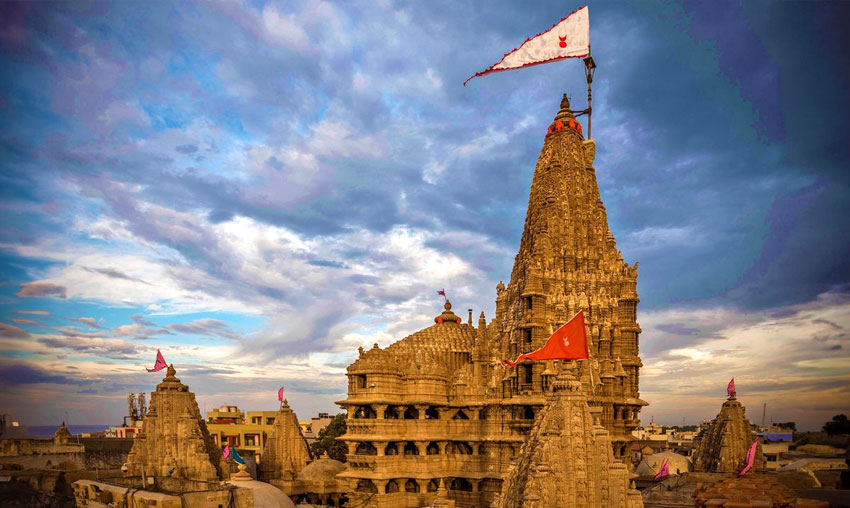
The temple is orientated westward and has a western architectural style. The temple’s design is based on the Sayanam position of the human body, with the Shiva Linga representing the head, the Sabha Mandap representing the abdomen, the porch decorated with idols representing the hands, and the entry representing the feet. Arches, columns, lotus-shaped capitals, and marble jalis are among the ornamental elements that adorn the 110-foot-tall temple. Its design also incorporates religious motifs like the swastik and kalash. This temple is particularly unique since the Gomugam is orientated eastward while the Shiva Lingam faces south.
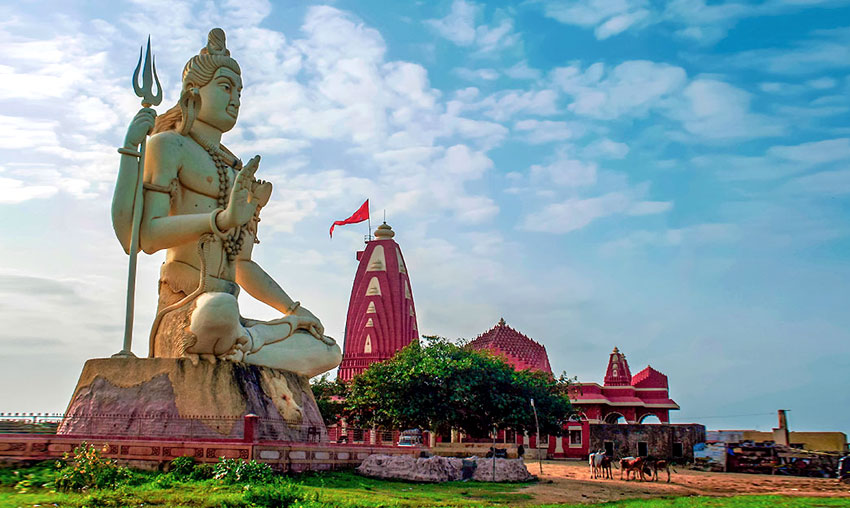
A Tri-Mukhi Rudraksha, the Shivalinga at Nageshwar is about 40 cm tall and 30 cm in circumference. Alongside the Shivalinga, visitors to Nageshwar can also see the goddess Parvati, also known as Nageshwari. Additionally, the temple complex’s 25-meter-tall statue of Lord Shiva enthrals pilgrims and visitors with its breathtaking splendour.
Festivals of Nageshwar Jyotirlinga Temple
Located in Devbhoomi Dwarka, the Nageshwar Jyotirlinga Temple is well-known for its yearly Maha Shivratri celebration, which happens in February or March. Thousands of people visit the temple to watch the celebrations on the eve of Maha Shivratri, when a massive Mela is hosted on the premises. Furthermore, the whole month of Shravan, which runs from July to August, is said to be very fortunate for Lord Shiva, and Mondays (Shravan Somvar) attract sizable crowds for rituals and prayers. Additionally, this place celebrates Navratri and Kartik Purnima with great fervour and grandeur.
Nageshwar Jyotirlinga Temple, Dwarka Dress Code
Although there isn’t a particular dress requirement at Nageshwar Jyotirlinga Temple, it is advised to wear modest clothes that covers your legs and upper arms out of respect. In addition to formal pants and shirts, males are expected to wear dhotis or pyjamas with an upper garment. Women can choose chudidhars, half sarees, or sarees. For the Abhishek ceremony, men must take off their shirts. While on the temple grounds, it is best to avoid wearing modern clothing such sleeveless shirts, shorts, and miniskirts.
Although entry to the sanctum sanctorum may be restricted, non-Hindus are welcome to visit the temple complex and take in its architectural grandeur.
Nageshwar Jyotirlinga Temple, Dwarka Timings
Monday: 6 AM – 12:30 PM & 5 PM – 9:30 PM
Tuesday: 6 AM – 12:30 PM & 5 PM – 9:30 PM
Wednesday: 6 AM – 12:30 PM & 5 PM – 9:30 PM
Thursday: 6 AM – 12:30 PM & 5 PM – 9:30 PM
Friday: 6 AM – 12:30 PM & 5 PM – 9:30 PM
Saturday: 6 AM – 12:30 PM & 5 PM – 9:30 PM
Sunday: 6 AM – 12:30 PM & 5 PM – 9:30 PM
Nageshwar Jyotirlinga Temple Entry Fee
Entry is Free
Special Pooja available for Rs. 300
Best Time to Visit Nageshwar Jyotirlinga Temple
October through March is the best time to visit Nageshwar Jyotirlinga Temple because of the town’s chilly winters, which are great for exploring the temple. It is advised to plan your visit during Maha Shivratri or the month of Shravan if you want to experience the temple at its most spiritually vibrant. During these times, the temple’s hallowed atmosphere is enhanced by elaborate ceremonies and festivals. The monsoon season, which runs from June to September, turns the surrounding area into a lush paradise, although the heavy rains can make travel challenging. On the other hand, because of the high temperatures, the summer months of April through June can be extremely harsh.
How to Reach Nageshwar Jyotirlinga Temple, Dwarka
The closest airport, Jamnagar Airport, serves direct flights from Mumbai and is approximately 126 kilometres from Dwarka. Okha, Tuticorin, Guwahati, Gorakhpur, Rajkot, Ahmedabad, Somnath, Allahabad, Varanasi, Puri, Rameswaram, Jaipur, Bhavnagar, Kochi, Howrah, Nathdwara, and Viramgam are all easily accessible by train from Dwarka Railway Station. Rajkot, Ahmedabad, Amreli, Porbandar, Somnath, Gandhidham, Bhuj, Gandhinagar, Baroda, Bhavnagar, Surat, Jamnagar, and Junagadh are all easily accessible by road from Dwarka. Nageshwar Jyotirlinga Temple is conveniently accessible by automobile, private taxi, or bus from Dwarka, approximately 15 km away.



Nearby Places to Visit